Beanie, scarf, gloves: the cold weather accessories guide
The three cheap pieces that decide whether you're warm at 35 degrees, and how to pick each one so they work together.
October 22, 2026 · 5 min read

The first properly cold morning always catches somebody out. Good coat, good boots, and then bare hands jammed in pockets, ears going red, a hoodie string pulled tight under the jacket because there's nothing else around the neck. The coat was the big purchase. The three small things that finish it never got bought.
They're cheap. A beanie, a scarf and a pair of gloves will run you $60 to $150 total, and at 35 degrees they matter more for comfort than the coat does. They also sit right next to your face and hands, so people notice them more than they notice your jacket.
The beanie: fold, fit, fiber
Most beanies go wrong in one of two ways. Too tall and slouchy, so there's a floppy bag of knit hanging off the back of your head. Or pulled so low and tight it reads like a swim cap.
What you want is a short cuffed beanie, sometimes called a watch cap or fisherman beanie. The cuff should sit at the top of your ears or just over the tips, and the crown should end close to your head with maybe an inch of air. If you have a longer face, a slightly taller beanie balances it. Rounder face, go shorter and let some hair show at the front.
Fiber matters more than people think. Acrylic is cheap and warm enough, but it pills, holds static and gets that shiny look after one winter. Merino or lambswool costs a bit more and looks better in month four than acrylic looks on day one. Cotton is fine for October, useless after.
Where to buy: the Carhartt Watch Hat (A18) at around $22 is acrylic but famous for a reason, and it comes in every color. Uniqlo's HEATTECH knit beanie is about $15. For real wool, Patagonia's Fisherman's Rolled Beanie is around $40, and Rag & Bone or Arket do merino versions in the $50 to $70 range.
Color: pick something your coat already agrees with. Charcoal, navy, olive, oatmeal or a rust/burnt orange if you want one thing in the outfit doing some work. If you need a refresher on why that works, the color matching guide has the short version.
The scarf: length and one knot
A scarf is the piece that makes a plain coat look finished. It's also the one guys skip because they don't know how to tie it. You need exactly one knot.
Get a scarf that's around 70 to 75 inches long and 10 to 12 inches wide. Shorter than that and the only option is a loose drape that blows off. Longer and you're wrapping it three times like a kid at a bus stop.
The knot is the Parisian, or the loop. Fold the scarf in half lengthwise, put it around your neck, then pull the two loose ends through the loop. Tighten as much as the wind requires. Four seconds, works under any collar, stays put.
Fabric: lambswool is the sweet spot. It's warm, doesn't itch much, and holds its shape. J.Crew and Uniqlo both do lambswool scarves in the $30 to $60 range, and Uniqlo's cashmere scarf is usually around $70, which is genuinely good value. If someone wants to buy you something nice this holiday, a Johnstons of Elgin cashmere scarf around $200 will outlast the coat you wear it with.
Pattern is where the scarf can carry some personality without much risk. A muted tartan or a simple check in navy and green looks good on almost everyone. Otherwise go solid in a color one shade off your coat: a gray scarf with a charcoal coat, camel with navy.
Gloves: the one you'll actually wear
Here's the thing with gloves. You'll only wear the pair that lets you use your phone, or the pair that looks good enough that taking them off and putting them back on doesn't feel like a chore.
There are two good answers and you can own both.
Knit touchscreen gloves are the daily pair. Uniqlo HEATTECH lined gloves run about $20 and work fine on a screen. They're the ones you keep in the coat pocket from November to March and don't worry about losing.
Leather gloves are the upgrade. A lined leather pair in brown or black looks sharp with a wool overcoat, handles wind better than any knit, and lasts a decade if you don't leave them on a radiator. Fownes and Dents make cashmere-lined leather gloves in the $60 to $90 range. Hestra is the next step up at about $130 and up.
Fit check for leather: snug through the fingers with no extra material at the tips, and you should be able to make a fist without the leather pulling hard across the knuckles. They'll stretch a little. Buy them slightly tight, the same logic as a new loafer.
Matching all three without looking like a set
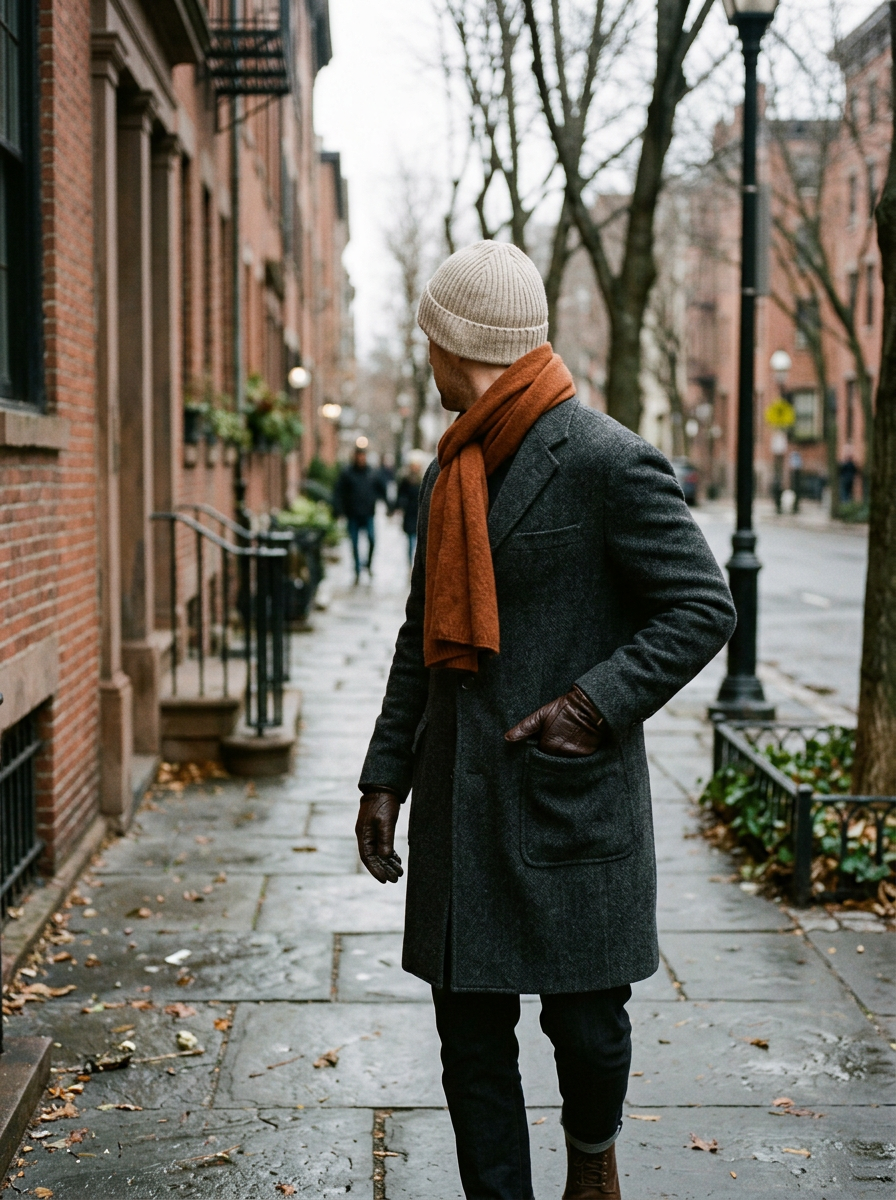
Don't buy a matching beanie, scarf and glove set. It reads like a gift box, because it usually is one. The goal is three pieces that look like they were picked separately but agree with each other.
The easy approach is one neutral, one color, one texture:
- Beanie in a neutral that ties to your coat (charcoal, navy, oatmeal)
- Scarf as the one spot of color or pattern (rust, forest green, a quiet tartan)
- Gloves in leather brown or black, matched to your shoes or belt
With a navy coat, that could be a gray beanie, a green and navy tartan scarf and brown leather gloves. With an olive field jacket, an oatmeal beanie, a rust scarf and dark brown gloves. Three pieces, none of them matching, all of them related.
If you're still deciding which temperatures call for which pieces, the 50 degree weather guide maps it out: beanie and scarf start earning their spot in the 40s, gloves under 40. And they sit right alongside the year-round accessories worth owning, the belt and the watch you wear every day.
Buy them this week
Cold weather accessories sell through by mid December, and the good colors go first. Grab a wool beanie and a lambswool scarf now while the stock is full. Keep a pair of $20 knit gloves in each coat you own, since you'll lose one pair by February anyway.