Beyond sneakers: the two pairs worth owning next
Loafers and boots cover the eight times a year sneakers can't. Which to buy, what they cost, and how to break them in without blisters.
August 6, 2026 · 4 min read

Your sneakers cover most of your life, and they should. One clean white leather pair, one with some grit, one you don't care about. That handles school, work, weekends, and most of everything else, which is the case we already made in the three-sneaker rotation.
The gap shows up maybe eight times a year. Dinner with someone's parents. A rehearsal dinner. An interview at a place that says business casual and means it. Rain in November. In those moments sneakers don't ruin the outfit, they just cap it. Everything above the ankle is doing real work and the shoes are answering a different question.
Two pairs close that gap permanently: a loafer and a boot. That's the whole list. You do not need a shoe wall.
Loafers do the easy half
A loafer is a slip-on dress shoe with no laces, and it's the least fussy way to look pulled together in August. No socks required, though wear no-show socks anyway: your shoes last longer and smell like nothing. They work with chinos, they work with dark denim, and they work with tailored shorts if you're feeling it.
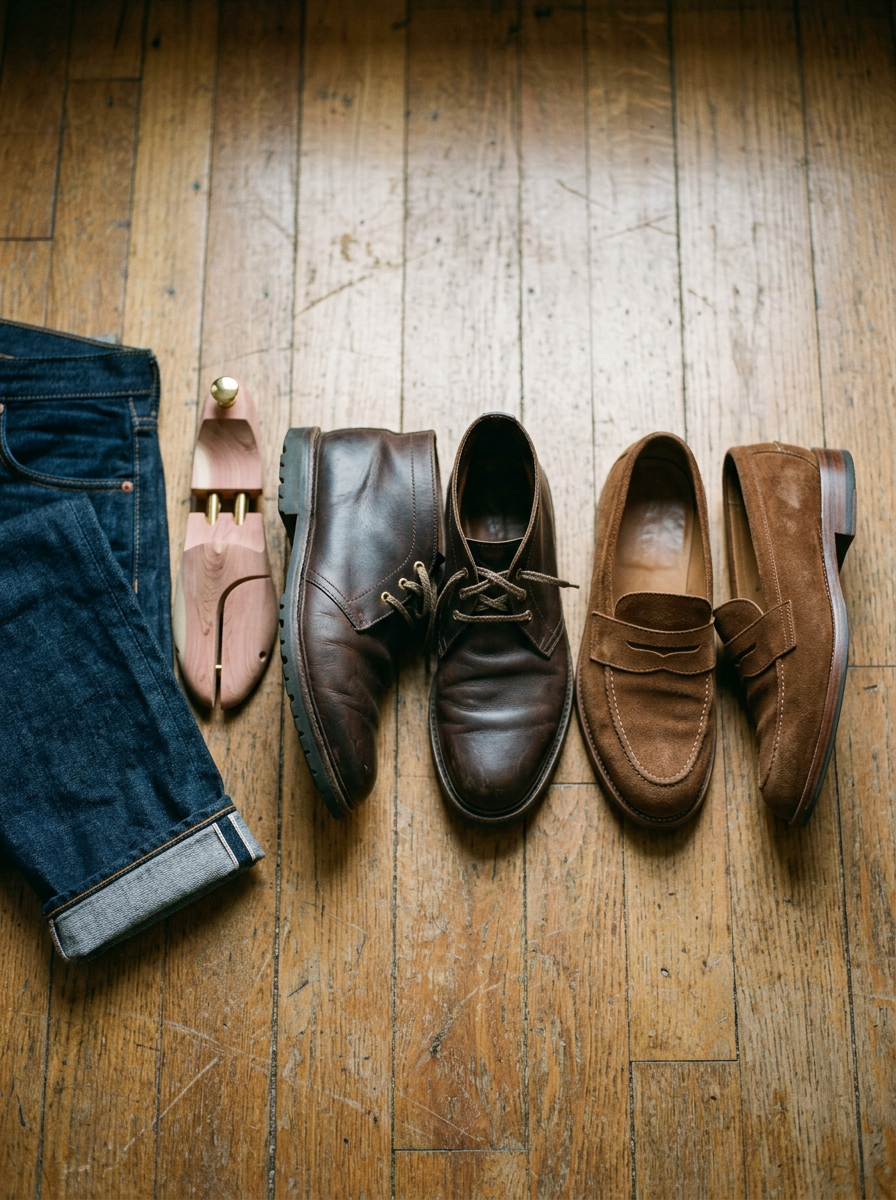
Three types are worth knowing. The penny loafer has the little leather strap across the front, usually brown or black, and reads preppy in the good way. The horsebit is the one with the metal hardware, a bit dressier and a bit louder. The suede driver has rubber nubs on the sole, sits lowest on the foot, and is the most casual of the three.
Start with a penny loafer in mid-brown suede or pebbled leather. Brown is far more forgiving than black, which pins you to dressier outfits. G.H. Bass Weejuns run around $175 and are the reference point everyone else is copying. Sperry makes a decent version near $110. If you want welted construction a cobbler can resole in five years, Meermin and Beckett Simonon land around $200 to $220 and are worth the jump.
One fit note that saves you a return: loafers should feel slightly snug when new, right up against too tight across the top of your foot. Leather stretches and there are no laces to take up the slack, so a pair that feels perfect in the store will slip at the heel by week three.
Boots carry the other half
A boot does the opposite job. It adds visual weight down low, which makes plain jeans and a tee look deliberate instead of accidental. This is the pair you'll live in from late September through March.
Chelsea boots have elastic side panels and no laces, the sleekest of the group, easiest with slim jeans. Chukkas have two or three eyelets, usually suede, and are the most casual and the most wearable in warm weather. Service boots, the Iron Ranger silhouette, run heavier with a lug sole and look better after a year of abuse than they do new.
Price map, roughly: Blundstone Chelseas sit near $220 and are close to indestructible. Thursday Boot Company runs about $199 with real leather and a resoleable sole. Dr. Martens 1460 is around $170 and takes a solid month to break in, which is not an exaggeration. Red Wing Iron Rangers run $350 to $380 and are a ten-year purchase if you brush them occasionally.
Pick based on your jeans, not on the boot. Slim or slim-straight legs want a Chelsea or a chukka. Straight and relaxed legs want the service boot, because the heavier shoe balances the extra fabric. If you're not sure what your jeans are actually doing down there, the jeans guide sorts that out before you spend anything.
The part nobody warns you about
Both of these hurt at first. That's normal and it's temporary, but only if you break them in correctly. Wear the new pair around the house for two or three evenings with thick socks before you take them outside. Then wear them for a half day, not a full one. Leather shoes are molding to your foot for the first 20 hours or so, and blisters happen almost entirely in that window.
Three things that make either pair last years instead of one season:
- Cedar shoe trees, $15 to $25 a pair. They pull moisture out and hold the shape, which is the single highest-return $20 in your closet.
- Never wear the same leather shoes two days running. They need a day to dry out. This is most of why cheap shoes crack early.
- A rubber sole guard from a cobbler runs about $20 to $30 and doubles the life of a leather sole. Get it done before you wear them, not after you've worn through the toe.
Suede gets its own rule: buy a $10 suede brush and a protector spray, hit the shoes once before the first wear, and brush them when they look flat. Suede is not fragile, it's just needy in one specific way.
Where they actually go
The loafer plus tapered chinos plus an oxford shirt is the smart casual answer for basically any dinner, and it costs you nothing you don't already own. That formula and a few of its cousins live in smart casual for men.
The boot plus dark straight jeans plus a plain crewneck or an overshirt is the fall version of the same trick. Add a leather belt that roughly matches the shoe color and you're done thinking about it.
If you want to see how either pair reads on you before you drop $200 on a guess, that's the entire point of Style.it: put the shoe on your actual body in your actual outfit and decide from there.
Buy the loafer this month, wear it for six weeks, and let the end of summer tell you whether you nailed the size. The boot can wait until the first genuinely cold morning, and it will be on sale by then anyway.