Workwear style for men: what it is and how to wear it
Chore coats, duck canvas and moc toe boots. The pieces, the fit, and three October outfits that skip the lumberjack costume.
October 7, 2026 · 4 min read

Workwear is the style you already half own. If you have a pair of raw-ish jeans, a canvas jacket, or a Carhartt beanie you bought because it was $20 and warm, you're in. The idea is simple: clothes originally built for farmers, railroad crews, mechanics and carpenters, worn by people whose hardest daily task is carrying groceries up three flights.
That sounds silly written out. It isn't. Work clothes were designed to survive abuse, so they're made from heavy fabrics, sewn with double stitching, and cut roomy enough to move in. Those same traits make them look better the longer you own them, which is the opposite of most of what's in a mall.
What actually counts as workwear
Workwear runs on three fabrics. Denim, obviously. Duck canvas, which is a tightly woven cotton that feels stiff as cardboard on day one and soft as an old tee by year three. And heavy twill, the stuff Dickies 874s are made of. Add flannel and waxed cotton for cold weather and you have nearly the whole palette.
The colors come from the same place. Tan, brown, olive, navy, indigo, black, and a faded cream sometimes called ecru. No neons, almost no prints beyond plaid and the occasional hickory stripe. That limited palette is why workwear pieces mix with each other so easily: you can grab any three without checking.
Key pieces, the ones you'll see on everyone who dresses this way:
- The chore coat. A boxy, unlined jacket with three or four patch pockets, originally French. Uniqlo has made a decent one around $60, Carhartt WIP's Michigan coat runs about $200, and Vetra or Le Laboureur are the real French versions at $150 to $250.
- The canvas jacket. The Carhartt Detroit or the classic duck chore coat with a corduroy collar. Around $130 from mainline Carhartt, and it will outlive you.
- Straight or relaxed jeans. Not skinny. A straight or slightly wide leg in mid to dark indigo. Levi's 501 or 555, Wrangler Cowboy Cut if you want the $35 option.
- Work pants. Dickies 874 ($35) or a carpenter pant with the hammer loop. Brown duck canvas is the move for fall.
- A heavy tee or henley. Something with real weight, 7 oz or more. Carhartt K87 pocket tees are around $20 and basically indestructible.
- Boots. Moc toe or plain toe leather work boots. Red Wing Classic Moc is the reference at about $350. Thorogood makes very similar boots near $250, and Timberland's 6 inch is the budget entry.
You don't need all six. Two or three, worn with the rest of your closet, gets you there.
How it should fit
This is where people go wrong in both directions. Workwear is supposed to be roomy, but roomy is different from sloppy.
Jackets should have space for a hoodie underneath without pulling across the back. Shoulders can drop an inch past your natural shoulder, that's part of the look. Sleeves can run a little long because you'll roll or bunch them. If you're between sizes on a chore coat, most guys should size up.
Pants are the harder call. A straight leg with a 7.5 to 8 inch leg opening reads right. Go too wide and you're in skate-shop territory, which is a different look. For length, a small stack or a single cuff is ideal. Workwear is one of the few places where a cuffed jean looks intentional instead of like you borrowed your older brother's pants. If you need a refresher on rise and taper, the jeans guide covers the measurements.
Tees and henleys should fit closer than the outer layers. That contrast, fitted base and relaxed shell, keeps the whole outfit from looking like a tarp.
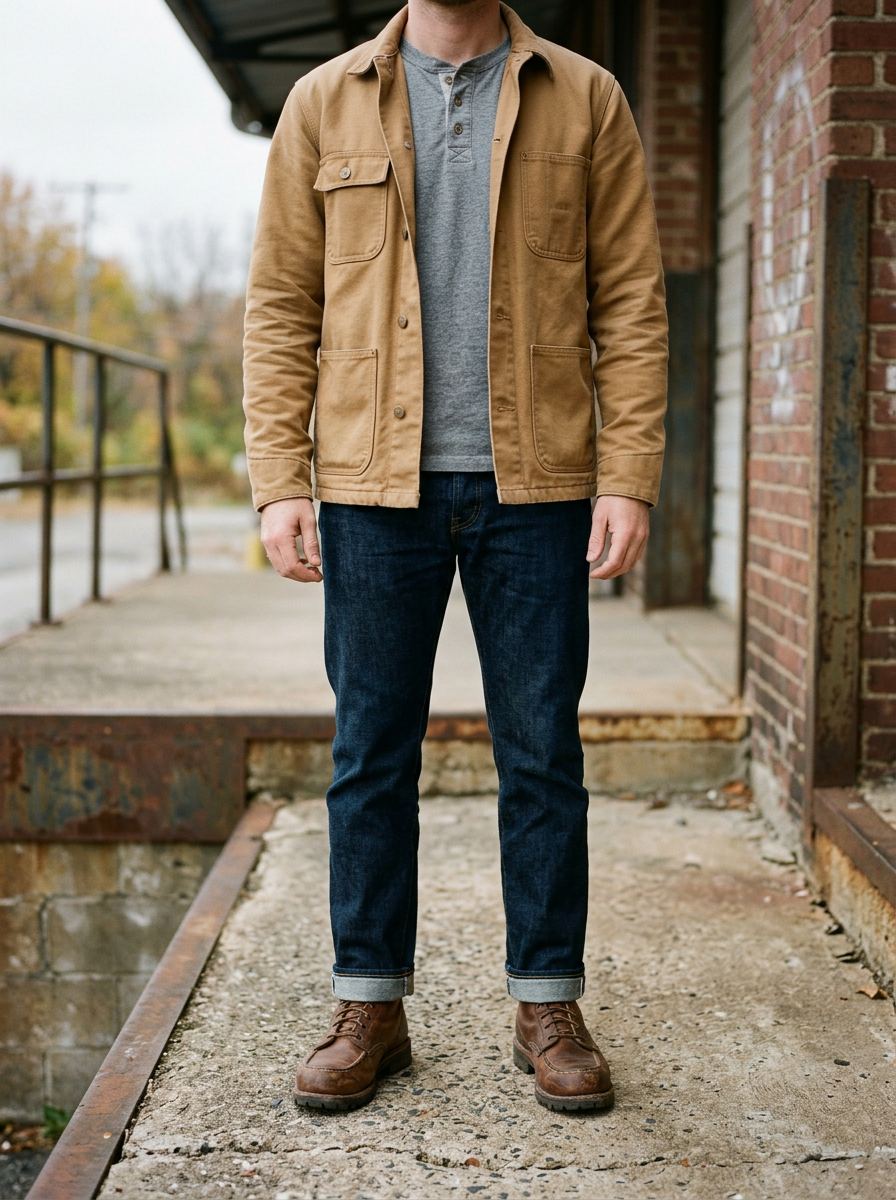
Three outfits for this month
October is workwear's best month. Cold enough for layers, not cold enough to bury them under a parka.
The weekend default. Grey heavyweight tee, brown duck canvas pants, olive chore coat, white leather sneakers or moc toe boots. Swap the chore coat for an overshirt if it's warmer than 60.
The dinner version. Navy chore coat, cream oxford shirt, dark straight jeans, brown leather boots. This reads put together without anything looking like it came from a suit store. The chore coat basically stands in for a blazer.
The cold morning. Plaid flannel under a canvas jacket with a corduroy collar, black or charcoal work pants, boots, a knit beanie in a solid color. Peak lumberjack, and honestly fine. Just keep the beanie plain.
Where people overdo it
Workwear tips into costume when every single piece is from the same catalog. Head to toe Carhartt, a full beard, a carabiner of keys and a pocket knife clipped to your waistband: now you're dressed as a job, not dressing in a style.
The fix is mixing. Wear the chore coat with a clean pair of New Balance 990s. Wear the work pants with a merino sweater. Let one or two pieces carry the workwear signal and keep the rest neutral.
The other trap is buying new things that are pre-distressed. The whole point of these fabrics is that they wear in from your life. A $90 pair of jeans with factory whiskers is paying extra to skip the only fun part. Buy them plain and dark, and wear them hard. If you'd rather start with something already broken in, secondhand is where real faded Carhartt lives, often for $30 to $50.
The one-piece starting point
If you're buying one thing this fall, make it a canvas chore coat in tan, brown or olive. It goes over every tee, sweatshirt and flannel you already own, it looks better each month you wear it, and it costs less than most fleece jackets. Wear it twice a week until Thanksgiving and see what it looks like by then.