Your first suit: what to buy and how it should fit
One navy wool suit covers interviews, weddings and holiday parties. What to pay, where to buy, and the fit checks that keep it from looking rented.
October 19, 2026 · 5 min read

Most guys buy their first suit the week they need it. A wedding invite lands, the interview goes to a second round, and you're at a mall on a Tuesday night pointing at whatever the mannequin has on. That suit is usually black, usually part polyester, and usually a size too big. You wear it four times and hate it every time.
One suit, bought on purpose, covers nearly every dressed-up moment between now and 30. Here's the whole decision.
Navy, wool, two buttons
Color first, because it's the one thing you can't fix later. Buy navy. Not black, not bright blue, not brown. Black reads as funeral or catering staff in daylight and drains the color out of most faces. Navy works at a 2 p.m. wedding, a 7 p.m. holiday party and a conference room, and it takes brown shoes or black ones without complaint. Charcoal is a close second and the right call if you're headed into finance or law. Mid-grey is the third suit, not the first. To see navy against charcoal on your own frame first, Style.it puts both on you in about a minute.
Fabric: 100% wool, and read the tag before the mirror. Department store suits at $200 to $300 are often a wool and polyester blend, and the poly is why a cheap suit shines under flash and holds heat like a trash bag. You want a four-season weight, roughly 9 to 11 ounces. Ignore the Super number arms race: 110s is plenty, and 150s feels softer in the store and wears out faster everywhere else.
Details that keep it from dating itself: two buttons, notch lapels about 3 to 3.5 inches wide, flat-front trousers with a slight taper. Skip the shiny shawl collar, the three-button and the contrast stitching. Boring is the goal. Boring is what lets you wear the same suit for six years without anyone noticing.
What it actually costs
Price mostly buys construction. Under about $400 the jacket front is fused, meaning the inner layer is glued on: fine new, bubbling after a dozen dry cleans. Above $400 you get half-canvas, a stitched layer through the chest and lapel that drapes better and lasts a decade. That's the one price jump worth making:
- $30 to $80, thrifted. A secondhand Brooks Brothers or Hugo Boss suit in wool, plus $100 of tailoring, beats most $400 suits off the rack. Only the shoulders have to fit. How to buy secondhand clothes covers the rest of the hunt.
- Around $200, suit separates. Uniqlo and that tier sell a jacket and trousers for about $200 total. The fabric is usually a blend, so you're trading the wool rule for the price. Fair trade at 19. Less fair at 27.
- $400 to $500. Spier & Mackay, around $400 to $450, is half-canvas, all wool, and the best value online. Suitsupply runs $500 to $700 with in-store alterations done the same week. J.Crew's Ludlow lands near $600 as separates and has the widest size run.
- Over $700. Not your first suit. Come back when the first one has been to 20 weddings.
Whatever you spend, add $60 to $150 for the tailor, because nothing off the rack fits as sold. Sleeves run $30 to $60, a trouser hem $15 to $25, taking in the jacket waist $30 to $50. What a tailor can fix has the full price list and what to skip.
The four fit checks
Buy the suit for the shoulders. Pay the tailor for everything else.
Shoulders decide the purchase. The seam should end right where your shoulder bone ends, with the sleeve hanging straight down from it. Seam past the bone, too big. A divot or a ripple just below the seam, too small, or the padding is fighting your shape. A tailor can't fix shoulders without rebuilding the jacket, so if this fails, put it back.
Chest and waist: fasten the top button only, never the bottom, and stand normally. You want a flat front with no X of strain pulling from the button, and enough room to slide a flat hand inside without forcing it. The waist should follow you in a little. Boxy is the most common off-the-rack problem and a $40 waist alteration fixes it.
Two lengths. The jacket should cover your seat, which usually means the hem sits about where your fingers curl with your arms relaxed. The sleeve ends at the wrist bone so a quarter to half inch of shirt cuff shows. That sliver of white is the single detail that makes a suit look like yours instead of rented.
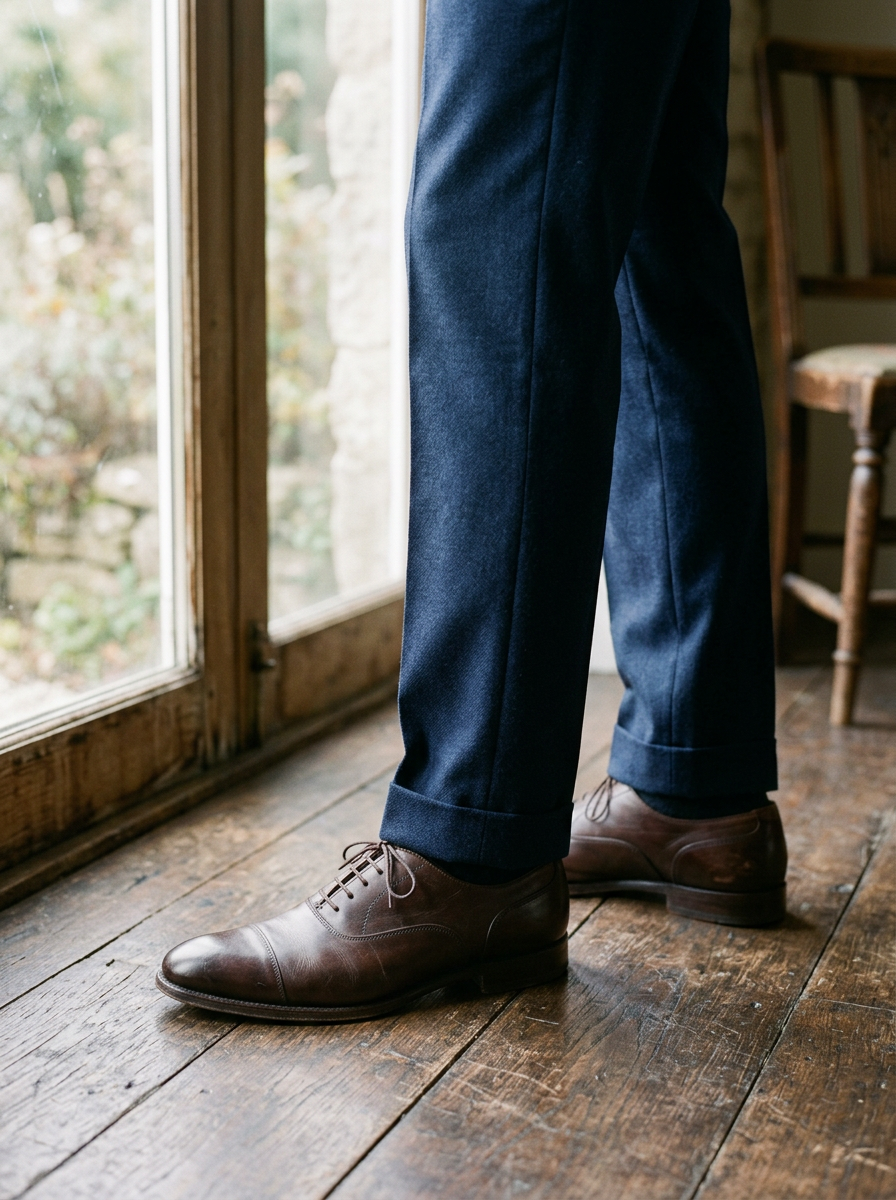
Trousers: a rise that sits at or just under your natural waist, a leg that tapers without clinging, and a hem with little to no break, meaning the fabric touches the shoe once or not at all. A puddle of cloth at the ankle ages a suit ten years.
What goes with it
Shirts: white and light blue, spread collar, slim enough that nothing balloons at the waist when tucked. Two at $30 to $60 from Uniqlo or J.Crew and you're set for years. Shoes: dark brown leather cap-toe oxfords or derbies, $130 to $200, and the belt matches the shoe. Socks match the trousers, not the shoes. One tie, navy grenadine or a textured burgundy, about 3 inches wide to match the lapel. Skinny ties are over. So are the 4-inch ones.
The same suit flexes by what you remove. Tie and oxfords: interview, and the job interview guide sorts out which industries still expect that. No tie, top button open, loafers: holiday party, rehearsal dinner. The trousers alone go with a grey crewneck for dinner. Don't run that in reverse. A smooth worsted suit jacket over jeans looks like you misplaced your pants. A jacket for jeans is a blazer, and that's the next purchase, not this one.
Keep it alive
Wide wooden hanger, not the wire one it came home on. Brush it after wearing with a $12 garment brush, steam wrinkles out while you shower, and dry clean once or twice a year at most: the solvent is what makes a $500 suit look like $100 by year three. Rest it a day between wears and it'll outlast three phones.
Go try one on this weekend, even a suit you can't afford yet. Button it, check the shoulders, look. Once you know what right feels like on your frame, the $450 version is an easy buy instead of a panic one.